Dictyoptera aurora (Herbst, 1784)
Introduction
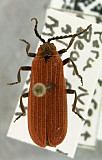
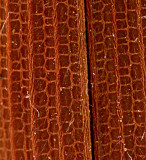
Beetles in the family Lycidae (~3,500 species worldwide; ~76 species North of Mexico) are commonly referred to as net-winged beetles; their elytra (forewings) are often soft and covered in a net-like, reticulate texture, thus the common name. They are similar in appearance and closely related to fireflies (Lampyridae), but do not bioluminesce. Lycids are conspicuous beetles – the adults and larvae are usually red, orange, or yellow, and oft en contrasted by black or dark colors. This aposematic (warning) coloration is used to show predators that they are distasteful. This week’s species is Dictyoptera aurora, sometimes called the “golden net-winged beetle”.
Taxonomic History
The genus Dictyoptera (=Dictyopterus Mulsant 1838) was described by Latreille in 1829. Dictyoptera aurora was described by the German entomologist Johann Friedrich Wilhelm Herbst in 1784, but was originally was placed in the genus Pyrochroa (now used exclusively for the type genus of fire-colored beetles, Pyrochroidae).
Diagnosis
The genus Dictyoptera can be told from other local lycids by the combination of 1) distally expanded 2nd antennomere, 2) pronotum with 2 longitudinal carinae forming a central diamond shape, and 3) 4 raised costae on elytra, making 10 rows of reticulations. Dictyoptera aurora can be further diagnosed from other Dictyoptera sp. in NC by having a red coloration except for the center of the pronotum, scutellum, legs and antennae, which are black. Dictyoptera aurora ranges from 6-13mm in length.
Natural History
These beetles are often seen in the spring in North Carolina (March-April). Adults sometimes feed on nectar and pollen from flowering plants; larvae inhabit soil, leaf litter and decaying wood where they are thought to be predators or mycophagous (feeding on fungus).
Habitat
Dictyoptera aurora is commonly found in temperate deciduous/coniferous forests. Larvae and adults can be collected around rotting wood, either on or from underneath the bark. Adults may be found on flowers or in flight.
Distribution
This species appears to be Holarctic, being widely distributed throughout much of North America and North Europe/Asia. Our specimens were collected mainly from North Carolina, but also from South Carolina, Maryland and New York.
Find out more
- Miller, R. S. 2002. 59. Lycidae. In: R. H. Arnett, M. C. Thomas, H. Frank and P. E. Skelley (eds.) American Beetles. Volume 2. pp. 174–178. CRC Press, Washington, D.C.
- Ladislav Bocak and Milada Bocakova. 2008. Phylogeny and Classification of the Family Lycidae (Insecta: Coleoptera). Annales Zoologici 58(4):695-720.
- Dictyoptera aurora(Herbst 1784) Encyclopedia of Life. Accessed 30 Sep 2010.
- Dictyoptera aurora on Bugguide.
Map
kml (right-click, save as)