Sphecius speciosus Drury
Introduction
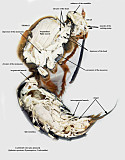
This week’s insect, the eastern cicada killer, is considered to be one of the largest wasps in the United States. However, these wasps are very passive and rarely attacks humans. Cicada killers belong to the family Crabronidae, all of which appear to have very weak stingers. Their venom is adapted to paralyzing their insect prey, not to causing pain and damage to vertebrates. In comparison to other wasps, bees, and ant venoms, cicada killer venom has a relatively high LD50. Although females have quite an impressive stinger, the Schmidt pain scale ranks the cicada killer at a 0.5 out of 4 rating. When the males appear in mid or late June, they usually display very aggressive behavior that strikes fear into people’s hearts. However, as in other stinging wasps, males of the cicada killer do not have a stinger, and hence they are harmful. In addition, their aggression is territorial and is usually against conspecifics. Whenever we do outreach about insects, and introduce our research on the functional morphology of muscle systems in Hymenoptera, one of the first questions from the audience is always “Do insects have muscles?” or “What kind of muscles do insect have?”. There are many ways of answering these questions, but we have realized that showing insect muscles is the best way to get the audience to understand that insect muscles are indeed very similar to those in vertebrates. Instead of publishing the 37601st habitus image of an eastern cicada killer, we have decided to show the wasp from another perspective: inside. Well, yes, insects do have muscles!
1.
Taxonomic History
Sphex speciosus was described by Drury in 1773. The holotype is lost, but it was most likely collected in the United States. Dahlbom proposed the presently valid combination, Sphecius speciosus, in 1843.
Diagnosis
There are 5 New World species of the genus Sphecius: S. convallis, S. grandis, S. hogardii, S. speciosus, and S. spectabilis. The eastern cicada killer shares the presence of yellow markings on the metasoma with only two other species: S. grandis and S. convallis. The general body color of the eastern cicada killer is black, whereas the body is usually rufous in most populations of the other two species. The shape of the 2nd and 3rd male flagellomeres and the sculpture of the 1st and 2nd metasomal terga (see Holliday and Coelho 2006) will help provide accurate identification of Sphecius species from the midwestern United States. Since the distribution of S. grandis and S. convallis is restricted to the western part of the United States, cicada killer specimens collected in North Carolina are most likely the eastern cicada killer.
Natural History
The eastern cicada killer is solitary (lives independently rather than in colonies and does not depend on other colony members to help raise larvae or maintain the nest). Female eastern cicada killers place paralyzed cicadas inside their nests as food for their offspring. The wasp captures cicadas in July and August and places them in cells at the ends of 10-24 inch deep tunnels which they dig in the ground. One or two paralyzed cicadas are placed in each tunnel, and a single egg is deposited by the female, who will never return after she closes the cell. The larva feeds on the cicadas and develops into adults that emerge the next summer. Adults feed on flower nectar and other plant sap exudates.
Habitat
Eastern cicada killers often prefer disturbed, wet (well-drained) areas with sparse vegetation in sunny locations.
Distribution
Eastern cicada killers occurs in Canada (southern Ontario), Guatemala, Honduras, northeastern Mexico and the eastern two-thirds of the United States.
Find out more
Sphecius speciosus (Drury 1773) species page at EOL
Sphecius speciosus (Drury 1773) species page at BugGuide
Coelho JR, Holliday CW and Hastings JM (2011) The geographic distributions of cicada killers (Sphecius; Hymenoptera, Crabronidae) in the Americas. The Open Entomology Journal 5: 31–38.
Holliday CW and Coelho JR (2006) Improved Key to New World Species of Sphecius (Hymenoptera: Crabronidae). Annals of the Entomological Society of America, 99(5):793-798.
Evans HE and O’Neill KM (2007) The Sand Wasps: Natural History and Behavior. Harvard University Press.
Sphecius speciosus (Drury 1773) species page at BugGuide
Coelho JR, Holliday CW and Hastings JM (2011) The geographic distributions of cicada killers (Sphecius; Hymenoptera, Crabronidae) in the Americas. The Open Entomology Journal 5: 31–38.
Holliday CW and Coelho JR (2006) Improved Key to New World Species of Sphecius (Hymenoptera: Crabronidae). Annals of the Entomological Society of America, 99(5):793-798.
Evans HE and O’Neill KM (2007) The Sand Wasps: Natural History and Behavior. Harvard University Press.
Map
kml (right-click, save as)