Neotettix proavus Rehn & Hebard, 1916
Introduction
This week’s North Carolina insect is Neotettix proavus Rehn and Hebard, 1916 (Orthoptera: Tetrigidae), commonly called the fork-face pygmy grasshopper, a relatively uncommon pygmy grasshopper that can be found throughout the state but mainly a elevations under 1000 m.
Taxonomic History
Rehn and Hebard (1916) described Neotettix proavus based on their observations of eight specimens collected in the southeastern U.S., mainly from Georgia (the holotype is from Macon in Bibb County, Georgia, collected July 30-31, 1913 by Helm and Hebard). One of the original specimens (a paratype) was collected in Murphy, North Carolina on July 25, 1903 by A. P. Morse. The type specimens are now at the Academy of Natural Sciences in Philadelphia. A couple years later a specimen from Tennessee was described as Cavotettix apterus Hancock, 1918. This species was promptly designated a junior synonym of Neotettix proavus, however, by Hebard in 1919. Rehn and Hebard (1916) also discuss some of the challenges we face in describing species and classifying grasshoppers on the genus Neotettix.
Diagnosis
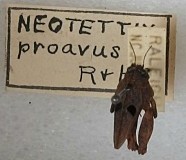
This small grasshopper has a more or less typical tetrigid habitus and a highly effective camouflage color pattern (mottled brown and gray). Reh and Grant (1956) offer a technical diagnosis: “pronotal profile as a whole arcuate throughout, or arcuate with a median flattening or subconcavity, in general sublamellate … lateral lobes of pronotum with caudal margin having the usual tegminal sinus subobsolete or at most a mere shallow concavity [variable]; scapular area of pronotum deep proximad. Tegmina small, usually in part or entirely concealed under the pronotum [variable].”
1.
Natural History
There are apparently no records of what this species eats.
Habitat
This species is mainly found in forested areas, primarily in association with deciduous trees. One can find them in sunny spots on the forest floor, in leaf litter and around mosses or on almost bare ground. Rehn and Hebard’s fields notes explain that specimens were found “… in damp sandy area of ravine deciduous forest among very scant herbage … [and] in leaf litter on almost bare ground of heavy forest of magnolia, gum and some holly and tulip trees.” (Rehn and Grant 1956 has a more complete account of the habitats in which specimens were collected.)
Distribution
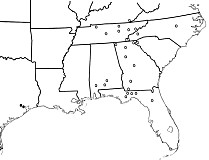
Specimens have been collected from as far south as Florida, west to Kansas, and north to at least Kentucky and North Carolina. Our specimens were collected in Raleigh, during two collecting events: [Raleigh NC Jun 7 28 BBFulton] and [Raleigh NC 30 March 1905 CMBentley].
1.
Distribution of Neotettix proavu...
↴
Find out more
- Neotettix proavus Rehn and Hebard, 1916 species page at the Orthoptera Species File website
- original description of Neotettix proavus Rehn and Hebard, 1916
- Neotettix proavus Rehn and Hebard, 1916 species page at BugGuide
- Neotettix proavus Rehn and Hebard, 1916 species page at GBIF
- Rehn, J. A. G. and H. J. Grant. 1956. A review of the genus Neotettix (Orthoptera; Acridoidea; Tetrigidae). Transactions of the American Entomological Society 82 (4): 217-250
Map
kml (right-click, save as)