Hyperaspis gemina LeConte, 1880
Introduction
This week’s North Carolina insect is Hyperaspis gemina LaConte, 1880, commonly known as the twin-spotted lady beetle. It’s a stunning little beetle but apparently rarely collected. In fact as of today there are no records from the Lost Ladybug Project and none in GBIF either. I did find a relatively recent record on BugGuide, though (from Norfolk, Virginia in 2008). Sweet!
Taxonomic History
This species was described by John LeConte, based on observations of two specimens – one collected in Georgia and the other in Texas – both of which are deposited at the Museum of Comparative Zoology, at Harvard. The Georgian specimen has since been designated as the lectotype, and it can be viewed through the MCZ type database. The description itself is part of a key, which makes it a bit more difficult to summarize the complete set of diagnostic characters for this species. Dobzhansky (1942), the famous geneticist, provides a decent redescription.
Diagnosis
Specimens are usually 2.8-4.0 mm long and 2.1-3.0 mm wide. Like almost all other coccinellid beetles, they tend to be oval and convex, with apparently three subdivisions of the tarsus. The head is yellow and the pronotum has a broad lateral, yellow area.The elytra (fore wings) have 2 narrowly-connected yellow areas near the posterior margin.
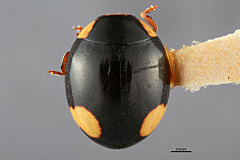
1.
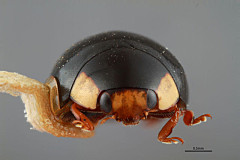
2.
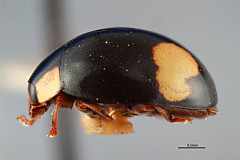
3.
Natural History
Like other Hyperaspis species H. gemina is most likely a predator of soft-bodies sternorrhynchans, like scales insects, mealybugs, and aphids. Some species are actually used in biocontrol programs, and are easily reared in the lab.
Habitat
Gordon (1985) and Dobzhansky (1942) each referred to Hyperaspis gemina as a rarely collected species, and it appears that he was right. Very little is known about its habits, other than it appears to be broadly distributed (at least TX to VA) and closely associated with the coastal plain.
Distribution
Gordon (1985) reports that specimens have been collected in North Carolina (Bell Island), South Carolina (Myrtle Beach), and Virginia (Cape Henry, Ft. Monroe). Dobzhansky (1942) also reports specimens from Wenona and Wilmington, NC. The 30 specimens in the NCSU Insect Museum were all collected in the coastal plain, from Fayetteville, NC south. The species hasn’t been seen in our state since 1952, according to data available right now.
Find out more
- Hyperaspis gemina Leconte, 1880 specimen records at GBIF. [0 records, accessed 2 August 2011]
- Dobzhansky, T. 1942. Beetles of the genus Hyperaspis inhabiting the United States. Smithsonian Miscellaneous Collections 101:1–94
- LeConte, J. L. 1880. Short studies of North American Coleoptera. Transactions of the American Entomological Society 8: 163-218.
- species page at BugGuide: http://bugguide.net/node/view/184043
Map
kml (right-click, save as)