Nephus intrusus (Horn, 1895)
Introduction
This week’s North Carolina insect is another ladybird beetle species, Nephus intrusus (Horn, 1895) (Coleoptera: Coccinellidae), which, as far as I can tell, has no common name – probably because it’s very small and seemingly quite rare!
Taxonomic History
This little ladybird beetle was originally described in 1895 by George Henry Horn as Scymnus intrusus, based on specimens collected in Maryland, North Carolina, Texas, Arkansas, and Missouri. It was classified in the subgenus Nephus by Korschefsky in 1931 and then treated as being in the the genus Nephus by Gordon in 1976. The lectotype is at Harvard’s Museum of Comparative Zoology. The here is one junior synonym of this species: Scymnus (Scymnobius) inops Casey, 1899.
Diagnosis
This beetle is small, mostly orange, sparsely setose (hairy-looking), and has a number of more technical diagnostic characters outlined in the original description. The primary character that separates this species from other small, orange ladybird species in this genus is that the metacoxal line is parallel to the suture but not reaching the lateral margin.
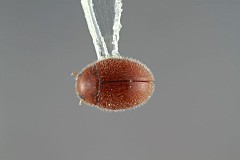
1.
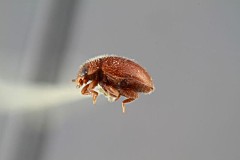
2.
Natural History
Very little is known about this species’ natural history, other than where and when it has been collected (see distribution). Nephus intrusus is known to each cochineal insects (Hemiptera: Dactylopiidae).
Distribution
N. intrusus is broadly distributed throughout the eastern USA, as far west as Wyoming and the Dakotas. Our two specimens are both from Mecklenburg County, North Carolina, collected in the 1950s. GBIF currently has only four records, all from the southern tip of Texas. This species also has yet to be reported to the Lost Ladybug Project.
Find out more
- Horn, G. H. 1895. Studies in Coccinellidae. Transactions of the American Entomological Society 22: 81-114.
- Nephus intrusus species page at BugGuide.
- Nephus intrusus species page at GBIF.
- Gordon, R. D. 1985. The Coccinellidae (Coleoptera) of America north of Mexico. Journal of the New York Entomological Society Vol. 93, No. 1: pp. i-iii, 1-912.
Map
kml (right-click, save as)