Halyomorpha halys Stål, 1855
Introduction
The brown marmorated stink bug, Halyomorpha halys Stål, is a pest that was first officially reported from the western hemisphere in Allentown, Pennsylvania in 2001 (Hoebeke and Carter 2003). It is a member of the family Pentatomidae, suborder Heteroptera.
Taxonomic History
Described by Stål in 1855, there is considerable confusion in the genus and a revision is needed. All references to Halyomorpha species in Japan, Korea, and east-China are Halyomorpha halys (Rider 2005).
Diagnosis
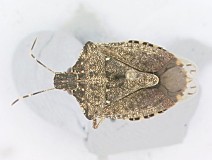
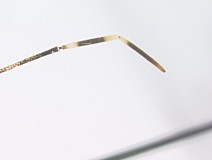
This stink bug is similar in appearance with Brochymena and Euschistus species. The easiest character for identification of the adults is the white bands at the base and apex on the fourth antennal segment. Also characteristic of this species is the exposed sides of the abdomen and the alternating light and dark areas of the lateral dorsal edge of the abdomen.
Natural History
In the northern part of its range, the brown marmorated stink bug has only one generation per year. In the southern parts of its native range it can have up to 5 generations per year. The adults mate in the spring approximately two weeks after emerging from diapause or the resting phase. After a short period, the females begin laying egg masses. Egg masses are laid at approximately weekly intervals, and each female lays as many as 400 eggs in her lifetime. Eggs hatch 4-5 days after being laid and the immatures go through 5 nymphal instars with each state lasting about one week.The brown marmorated stink bug is polyphagous, and is a pest of several important crops in its native range. In Japan it attacks shade and fruit trees, vegetables, and leguminous crops. In southern China, it feeds on flowers, stems and pods of various legumes. In the US, the brown marmorated stink bug feeds, beginning in late May or early June, on a wide range of fruits, vegetables, and other host plants including peaches, apples, green beans, soybeans, cherry, raspberries, and pears. It is a sucking insect, a “true bug”, that uses its proboscis to pierce the host plant in order to feed. This feeding results, in part, in the formation of small, necrotic areas on the outer surface of fruits but ranges from leaf stippling, cat-facing on tree fruits, seed loss, and transmission of plant pathogens. In addition to the damage of fruit and vegetables the brown marmorated stink bug can be a huge nuisance to home owners by invading homes in the fall to look for overwintering sites. They will work their way under siding, into soffits, around window and door frames, under roof shingles and into any crawl space or attic vent which has openings big enough to fit through. Once inside the house they will go into a state of hibernation where they wait for winter to pass, but often the warmth inside the house causes them to become active, especially in winter months, and they will fly clumsily around light fixtures. Luckily this overwintering behavior has not been reported yet in North Carolina.
Distribution
The brown marmorated stink bug was accidentally introduced into the United States from China or Japan. It is believed to have “hitched a ride” as a stowaway in packing crates. The first documented specimen was collected in Allentown, Pennsylvania, in September 1998. Since its introduction this species has quickly spread throughout the mid Atlantic states as far west as Michigan and Minnesota and as far south as Tennessee and North Carolina. Our first documented specimen in North Carolina was collected in February of 2009 in Raleigh (Wake Co.). Also in 2009 digital images were sent to the NCSU Disease and Insect Clinic from Winston-Salem (Forsythe Co.), Greensboro (Guliford Co.) area and the Dismal Swamp State Park (Camden Co.).
Find out more
- Hamilton GC, Shearer PW. (September 2003). Brown marmorated stinkbug-a new exotic insect in New Jersey. Rutgers Cooperative Extension.http://www.maine.gov/agriculture/pesticides/gotpests/bugs/factsheets/brown-marm-stink-nj.pdf (10 January 2011).
- Hoebeke, E. R., & Carter, M. E. 2003. Halyomorpha halys (Stål) (Heteroptera: Pentatomidae): A polyphagous plant pest from Asia newly detected in North America. Proc. Entomol. Soc. Washington. 105: 225-
237.
- MIPSP. (February 2008). Brown marmorated stink bug. Massachusetts Introduced Pests Outreach Project. http://www.massnrc.org/pests/pestFAQsheets/brownmarmoratedstinkbug.html (2 July 2009).
- NAPIS (May 2009). Reported status of brown marmorated stink bug, Halyomorpha halys. National Agricultural Pest Information System Pest Tracker. http://pest.ceris.purdue.edu/searchmap.php?selectName=IQAQQKA (2 July 2009).
- Nielsen AL, Hamilton GC. 2009. Seasonal occurance and impact of Halyomorpha halys (Hemiptera: Pentatomidae) in tree fruit. Journal of Economic Entomology 102: 113-1140.
- Rider (September 2005). Halyomorpha halys Stål, 1855. Pentatomoidea Home page. http://www.ndsu.nodak.edu/ndsu/rider/Pentatomoidea/Species_Cappaeini/Halyomorpha_halys.htm (8 July 2009).
Map
kml (right-click, save as)