Dissosteira carolina (L.)
Introduction
The Carolina grasshopper or locust, Dissosteira carolina (Linnaeus) (Orthoptera: Acrididae), is one of North America’s largest grasshoppers. Due to its size, colorful wings, and habit of flying over dirt roads and other bare ground it is very conspicuous. It can be seen in large numbers along farm turn rows, dirt roads, and fence lines. D. carolina is a strong flier and can disperse up to several miles to forage on both grasses and forbs. Populations usually occur in disturbed areas feeding on weeds, but occasionally cause economic damage to crops.
Taxonomic History
D. carolina was first described by Linnaeus in 1758. However, the type has since been lost. The type of Gryllus (Locusta) carolinus has been assigned as the neotype. Synonyms include Acridium carolinum (Linnaeus, 1758), Gryllus carolinus Linnaeus, 1758, and Locusta carolina (Linnaeus, 1758).
Diagnosis
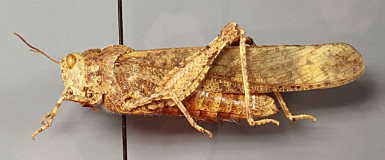
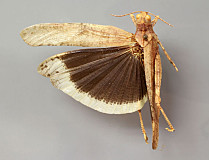
The Carolina grasshopper is 1 3/8- 2" and cinnamon-brown to grayish tan, matching the color of dry soil. The wingspread of the males measures 3 inches and that of the females 3 1/2 to 4 inches. The hind wings are black with a broad, pale, yellow or greenish border and the tegmina are faintly-speckled, tan, brown, or gray, and match the general body color. The pronotum has a high, narrow middle ridge. The nymphs are identifiable by their color patterns, shape, and external structures.
Specific characteristics include the following:
1. Head with face nearly vertical; antennae filiform, terminal segments dark, basal segments colored like body; lateral foveolae small and triangular.
2. Pronotum with median carina strongly elevated and cut once.
3. Hind femur with medial area evenly colored like body, may be spotted in instars IV and V; inner knee tan or fuscous, basal half of inner medial and lower marginal areas fuscous, distal half with two pale yellow transverse bands; hind tibia of instar I and II black with basal annulus pale yellow, hind tibia of instars III to V with variable patterns of tan, gray, and black; hind tarsus white or pale yellow except distal end fuscous.
Specific characteristics include the following:
1. Head with face nearly vertical; antennae filiform, terminal segments dark, basal segments colored like body; lateral foveolae small and triangular.
2. Pronotum with median carina strongly elevated and cut once.
3. Hind femur with medial area evenly colored like body, may be spotted in instars IV and V; inner knee tan or fuscous, basal half of inner medial and lower marginal areas fuscous, distal half with two pale yellow transverse bands; hind tibia of instar I and II black with basal annulus pale yellow, hind tibia of instars III to V with variable patterns of tan, gray, and black; hind tarsus white or pale yellow except distal end fuscous.
1.
2.
Natural History
D. carolina males court females by producing a calling signal by rubbing one hindleg at a time against the tegmen. This behavior is called called alternate stridulation. After mating, females typically lay egg masses containing 20-70 individual eggs either in the ground or on vegetation. The eggs hatch in the spring and go through 5 nymphal instars. The nymphs’ speckled bodies are well camouflaged and blend inconspicuously with ground. Once the grasshoppers develop functional wings they disperse. In flight they produce a crackling or whirling noise.
Habitat
Dissosteira carolina is commonly encountered in disturbed areas including roadsides and dry fields.
Distribution
Dissosteira carolina is found throughout the United States and Southern Canada.
Find out more
- 2008. The Grasshoppers (Orthoptera: Acrididae and Romaleidae) of Nebraska. University of Nebraska Extension. link to pdf
- Carolina Grasshopper information
- Pictures
- Dissosteira carolina on Bugguide
Map
kml (right-click, save as)