Diapheromera carolina Scudder, 1901
Introduction
We haven’t covered any native walking sticks (order Phasmatodea) in the North Carolina Insect of the Week series yet, so this week—our last one of 2010!—I highlight what appears to be North Carolina’s rarest phasmatodean: the Carolina walkingstick, Diapheromera carolina Scudder, 1901 (Diapheromeridae). I can find records for only ten specimens, and none seen since 1996!
Taxonomic History
Samuel Scudder described this species based on a single male specimen collected at an unnamed North Carolina locality: “North Carolina (Morrison).” Morrison, I assume, was the collector. The holotype is deposited in the Academy of Natural Sciences, in Philadelphia. His species description is a lot more detailed than many of the Hymenoptera species descriptions I have to deal with from that time period, but statements like this are tantalizing: “In most features this species stands nearly intermediate between deticrus and D. femorata.” I wonder if anyone has followed up with more data, for example from host plants or this walking stick’s genomes … hmmmm … sounds like a cool undergrad project.
Diagnosis
Relatively small, slender (females up to 8.4 cm long), brownish in color. Male cerci conspicuously arcuate, evenly broad throughout. Middle and hind femora of the male without conspicuous spines beneath, except the subapical spine. Ninth abdominal segment of male apically inflated, approximately 50% broader apically than proximally, the seventh and eighth segments of nearly equal in length. Pronotum with thick median dark stripe that extends onto the mesonotum (seen below in my cruddy camera phone image below; see also our fantastic GigaPan snapshot: http://gigapan.org/conversations/187068/). See Tilgner and McHugh (1997) for a more detailed discussion of diagnostic characters.
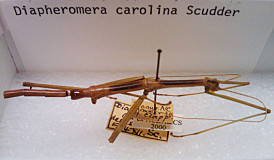
1.
Natural History
There are no published accounts that describe what the Carolina walking stick eats, but it’s undoubtedly plant-derived. Other Diapheromera spp., especially D. femorata , are important consumers of tree leaves, including oaks and other hardwoods, and can become pestiferous on forests. It’s possible that D. carolina forages on the mature leaves of multiple trees, but it may also be a specialist on some narrowly distributed plant in the southern Appalachians.
Distribution
Localities reported by Tilgner and McHugh (1997) indicate a southern Appalachian distribution (confirmed by our single specimen; see map below):
GEORGIA: Gordon Co., Calhoun, interstate stop off hwy 53,19/VII/ 1996, Coll.: C. NeSmith, 1 female, (UGCA). NORTH CAROLINA: Lake Toxaway. SOUTH CAROLINA: Greenville Co., Greenville, 26/X11/978, Coll.: S. Dudash, 1 female, (CUAC); Oconee Co., Mt. Rest, 27/VI/1981, Coll.: Miles Jones, 1 male, (CUAC); 30/VII/1977, Coll.: D. Allen, 1 male, (CUAC); Yellow Bridge Picnic Area, 19/VII/1983, Coll.: John Morse and H. Malick, 1 female, (CUAC); North fork of Limber Pole Creek at SC hwy. 130, ca. I960’ alt., collected 19/VI/1987, died 4/VIII/1987, Coll.: Hamilton and Hoffman, 1male, (CUAC); Pickens Co., Rocky Bottom, 3/VII/1934, Coll.: J. N. Todd, 1 male, (CUAC).
Find out more
- Samuel H. Scudder. 1901. The species of Diapheromera (Phasmidae) found in the United States and Canada. Psyche 9 (300): 187-189. doi: 10.1155/1901/38290
- Erich H. Tilgner and Joseph V. McHugh. 1997. Diapheromera carolina Scudder (Phasmatodea: Heteronemiidae), first description of the female form and new range records. Transactions of the American Entomological Society 123 (3): 191-196. http://www.jstor.org/stable/25078635
- Diapheromera carolina Scudder, 1901 species page at GBIF: http://data.gbif.org/species/13775113/
- The NCSU Insect Museum’s single specimen, in situ : http://gigapan.org/conversations/187068/
Map
kml (right-click, save as)