Cyrtolobus vau (Say, 1831)
Introduction
This week’s insect, Cyrtolobus vau is one of the most commonly collected species of the family Membracidae (Hemiptera) in eastern United States. Membracidae, together with Aetalionidae, Melizoderidae compose the seemingly monophyletic group (i.e., these species all evolved from a single common ancestor and all the descendents of that ancestor are classified in the superfamily Membracoidea), that is represented by more than 3,500 species world wide.
Taxonomic History
Cyrtolobus vau was described initially as Membracis vau by Thomas Say in 1831. Later, the species was reclassified into different hemipteran genera, including Similia and Thelia, and eventually into Cyrtolobus by Goding in 1893.
Diagnosis
All Cyrtolobus species exhibit sexual dimorphism and considerable individual variation in regard to color and pronotal markings. Consequently the identification of species in this genus proves to be the greatest problem among North American membracid genera. The relatively small (length: 5.5–6.5 mm; width: 2.4–2.6 mm) species is characterized by the special pattern of the pronotum (Figure 1.): transverse band prominent, pale bordered with deep brown, dorsal compression deep and translucent. For identification key of North American Cyrtolobus species see Kopp & Yonke 1973.
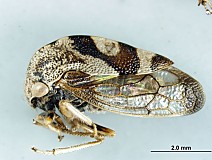
1.
Figure 1. Brightfield image of cy...
↴
Natural History
Cyrtolobus vau is a fairly common species in North Carolina. Individuals of the species can be found on almost all oak varieties (white oak, bur oak, black oak, red oak, hickory, blackjack oak, chinquapin oak, post oak, Shumard’s oak), on hickory, on sweet gum and occasionally on chestnut. Cyrtolobus vau females lay their eggs both in stems and buds during the fall. Eggs laid in September are overwintering and the first stage nymphs of the first generation emerge in May. The insects reach their maturity in June. Males are less numerous than females through the season. Mating and egg laying starts within one week from the emergence of adults. Attendance of the species by ants has been reported. usually univoltine (one generation per year), but sometimes bivoltine (two generation per year).
Habitat
Cyrtolobus vau occurs in any habitats where its host oak species (Quercus sp.; see above) are represented.
Distribution
Cyrtolobus is the largest genus in the tribe Smiliini in North America and contains 44 species. Cyrtolobus vau is widely distributed in the eastern United States. The most western states where from the species has been recorded are: Texas, New Mexico, Nebraska, Iowa and Wisconsin. For distribution map of the species see Kopp & Yonke 1973.
Find out more
- Cyrtolobus vau on Encyclopedia of Life
- Cyrtolobus vau on BugGuide
- Treehopper website at insectmuseum.org
- Funkhouser WD (1919): Biology of the Membracidae of the Cayuga Lake Basin. Cornell University, Itthaca, NY, 269 pp.
- Kopp DD & Yonke TR (1973) The Treehoppers of Missouri: Part 3. Subfamily Smiliinae; Tribe Smiliini. Journal of the Kansas Entomological Society, 46: 375–421.
Map
kml (right-click, save as)