Calopteryx dimidiata Burmeister
Introduction
The genus Calopteryx Leach is a Nearctic genus of damselfly in the family Calopterygidae. Calopterygids are well known for their metallic coloration and wing patterning. These damselflies, like all other odonates are predatory as juveniles and adults. Calopteryx dimidiata is one of the more impressive looking damselflies, it is also known as the sparkling jewelwing.
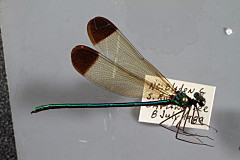
1.Male
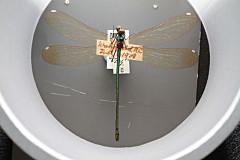
2.Female
Taxonomic History
Johnson (1973) describes the rather colorful taxonomic history of Calopteryx dimidiata. Burmeister (1839) separated this species into to two, C. apicalis and C.dimidiata. Hagen (1889) revised the genus and sunk C. apicalis into C. dimidiata, apicalis was considered a subspecies based on slightly differing body lengths. The body lengths were later noted to be incorrect (Johnson 1973). One interesting note about Hagen’s (1889) revision is the fact that he miss quoted the page numbers in Burmeister’s (1889) paper, giving page preference to C. dimidiata rather than C. apicalis. Kirby (1890) transferred the two species to the genus Agrion, unfortunately, Say (1840) had described a species of coenagrionid as Agrion apicalis (now known as Agria apicalis) which caused homonymy problems which were later resolved (Johnson 1973). In the early to mid-1900’s, there was a continued use of the two species names despite Hagen’s revisionary work. Finally, Johnson (1973) puts the whole problem to rest by discussing this history of this species and once again uniting the two species into C. dimidiata.
Diagnosis
Males have apical black bands on all wings. abdominal sternum 10 black, not white or cream colored. Females may or may not have apical black bands on wings, sometimes bands may only be present on hind wings. Length of the wings equals width X 4 or less. The labrum and labium are the same color as the rest of the body (metalic black, blue or green, not pale cream color). Stigma may or may not be present, if present, longer than 2mm.
Natural History
Waage (1983) reported on the mating and oviposition behaviors of C. dimidiata. The females give signals to courting males; wing spreading (rejection), wing flipping (acceptance), and no movement (neutrality). Males give up after a rejection or neutral signal, which is different from C. maculata in that C. maculata males don’t give up. There is also a difference in the oviposition behaviors of these two species, C. dimidiata females submerge themselves to oviposit, while C. maculata females oviposit on the surface. This difference has an effect on the abilities of males to interrupt oviposition.
Habitat
The adults and nymphs, or naiads as juvenile aquatic insects are often referred to, inhabit streams and small rivers.
Distribution
C. dimidiata is a widespread species that has been found along the gulf coastal states from Texas to Florida, and along the eastern coastal states from Florida to New Jersey. The Range extends inland just enough to reach Tennessee. This species can be found across North Carolina from the coastal plains to the Blue Ridge Mountains (Johnson 1973).
Find out more
- Burmeister, H. 1839. Handbuch der Entomologie. Zweiter Bande. Berlin:Theod. Chr. Friedr. Enslin. xii + 757-1050.
- Hagen, H. A. 1889. Synopsis of the Odonata of North America. No. 1. Psyche 5:241-250.
- Johnson, C. 1973. Distribution and Taxonomy of Calopteryx dimidiata (Zygoptera: Calopterygidae). The Florida Entomologist 56(3):207-222.
- Kirby, W. F. 1890. A synonymic catalogue of Neuroptera Odonata, or dragonflies, with an appendix of fossil species. London: Gurney and Jackson. ix + 202.
- Say, T. 1840. Descriptions of North American neuropterous insects and observations on some already described. J. Acad. Nat. Sci. Phil. 8:9-46.
- Waage, J. 1983. Female and male interactions during courtship in Calopteryx maculata and C. dimidiata (Odonata: Calopterygidae): Influence of oviposition behavior. Animal Behavior 32(2):400-404.
Map
kml (right-click, save as)