Atlides halesus (Cramer, 1777)
Introduction
This week’s North Carolina insect, Atlides halesus, is a colorful butterfly (Lepidoptera: Lycaenidae) which is relatively common in the coastal plain, but rare in the piedmont. Atlides halesus is commonly called the Great Purple Hairstreak. However, its brilliant iridescent scales on the upper surface of the wings are blue NOT purple. Unfortunately you can only see this color while the butterfly is in flight, not at rest.
Taxonomic History
Atlides halesus was first described by Cramer in 1777 under the Genus Papilio. It was later moved to the genus Atlides by Hübner in 1819. Synonyms of A. halesus include A. dolichos (Hübner 1823) and A. juanita (Scudder 1868), both described from specimens collected in Florida.
Diagnosis
The upper sides of the wings are iridescent blue with black borders while the undersides of the wings have three basal, bright red spots (one on the front wings and two on the hind wings). The hind wing also has 2 black tails, one short and one long called hairstreaks. The wingspan of the adult is 14 to 24 mm. The top of the abdomen is blue with red-orange beneath. The sexes also differ externally: males have an iridescent blue patch on the underside of their fore wings (visible when their wings are folded at rest; see ventral photo) which females lack.
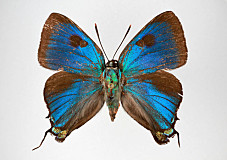
1.dorsal
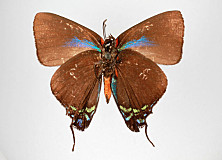
2.ventral
Natural History
In the afternoon the males perch on tall objects to wait for a receptive female for mating. As the butterfly sits, it moves itshind wings up and down. This action, along with the colored markings on the wings, is thought to attract predators to the lower part of the wing which then tears away allowing the butterfly to make a safe escape. The caterpillars (larvae) feed only on parasitic mistletoe and later migrate off the mistletoe to crevices on the tree or even on adjacent buildings. It is common to find A. halesus pupae parasitized by parasitoid wasps and flies. Adult food includes the nectar from flowers including goldenrod, Hercules club, shepherd’s needle, sweet pepperbush, and wild plum.
Habitat
Most areas where mistletoe is found including forests and suburban areas.
Distribution
The great purple hairstreak is found throughout the southern United States as far west as Central California and along the east coast up into New York and Maryland. It can be found as far south as Guatemala.
Find out more
- NC images
- Duke images
- Butterflies and Moths of North America: Atlides halesus
- 2008. Jonathan P. Pelham. CATALOGUE OF THE BUTTERFLIES OF THE UNITED STATES AND CANADA. The Journal of Research on the Lepidoptera. 40: 200
Map
kml (right-click, save as)